31 July 2026
How to Scale Recipe Servings Without Guesswork
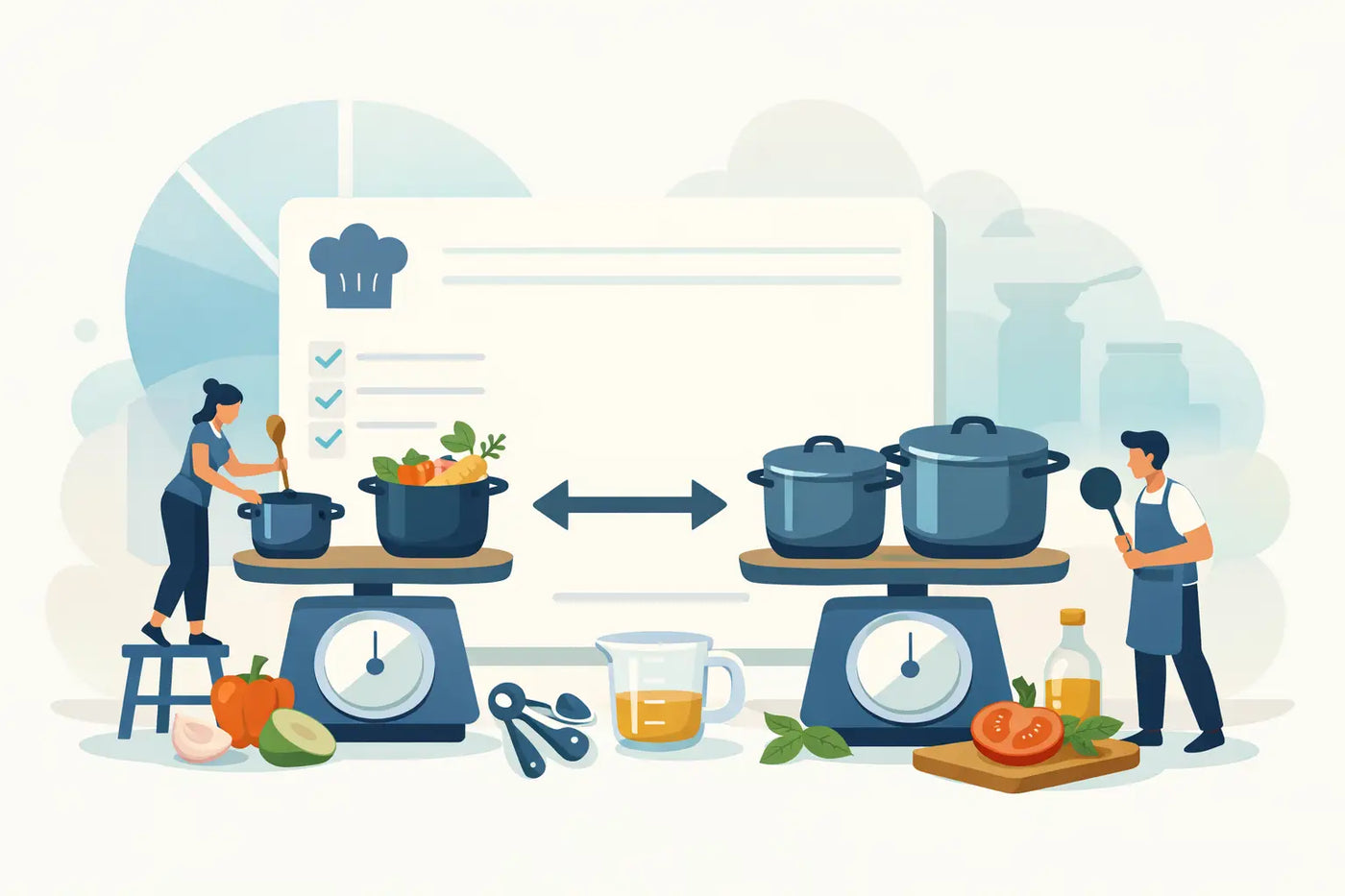
A recipe written for four can become a dinner for two, a lunch plan for one, or a meal for eight guests. The math is simple. The results are not always. Knowing how to scale recipe servings means adjusting quantities without creating a bland sauce, a crowded pan, or a refrigerator full of food nobody will eat.
A reliable serving system does more than multiply ingredients. It connects the recipe to the people eating it, the groceries you need, the nutrition you track, and the leftovers you actually want. Get the factor right first. Then make the few judgment calls that cooking requires.
How to scale recipe servings: start with one factor
Every scaled recipe begins with the same calculation:
Desired servings ÷ original servings = scaling factor
If a recipe serves 4 and you need 6 servings, divide 6 by 4. Your scaling factor is 1.5. Multiply each ingredient by 1.5.
If the same recipe serves 4 and you need 2, divide 2 by 4. Your factor is 0.5. Use half of each ingredient.
This sounds obvious, but the most common mistake is working from memory and changing each item separately. One ingredient gets doubled. Another gets increased by half. The result may still be edible, but it is no longer the recipe you intended to make.
Write down the factor or use a recipe tool that applies it consistently. This is especially useful when the recipe includes a dozen ingredients, mixed units, or nutrition details you want to keep accurate.
A quick example
Suppose a chili recipe serves 4 and calls for 1 pound of ground turkey, 2 cans of beans, 1 can of tomatoes, 1 onion, and 2 teaspoons of chili powder. You need 6 servings.
Your factor is 6 ÷ 4 = 1.5. The scaled recipe calls for 1.5 pounds of turkey, 3 cans of beans, 1.5 cans of tomatoes, 1.5 onions, and 3 teaspoons of chili powder.
That 1.5 cans of tomatoes creates a practical choice. Use one 28-ounce can instead of measuring half of a second can, or use two smaller cans and save what remains. Good scaling includes this kind of packaging decision. Exact math is the starting point, not the finish line.
Choose servings based on real portions
Recipe serving counts are estimates. A casserole labeled “serves six” may feed six children, four hungry adults, or two adults with lunches for the next day. Before you scale, decide what a serving means in your household.
For dinner, consider the full plate. If the main dish is paired with rice, vegetables, bread, or a salad, the stated serving count may work well. If the recipe is the entire meal, you may need more. Fitness-focused households may also plan around a protein target rather than the author’s serving label.
Leftovers change the calculation, too. If two people want dinner tonight and lunch tomorrow, plan for four servings. That is different from simply doubling a two-serving recipe because you are assigning every portion a purpose before you shop.
A useful habit is to record your own yield after cooking. Perhaps a soup labeled as six servings gives your household four satisfying bowls. Next time, use your household’s number. Your kitchen is the standard that matters.
Scale ingredients, then use judgment
Most ingredients scale cleanly. Meat, grains, canned goods, vegetables, broth, yogurt, and sauces generally follow the factor exactly. Small-volume ingredients need more care.
Salt, hot peppers, dried herbs, garlic, acids, and concentrated flavorings can become too strong when multiplied without tasting. Start slightly below the calculated amount for these ingredients, then adjust near the end. It is easy to add salt or lemon juice. It is much harder to take either away.
Baking is less forgiving. For cookies, muffins, breads, and cakes, weigh ingredients when possible. Flour packed into a cup varies enough to matter, especially when you are scaling by 1.5 or cutting a recipe in half. Eggs can also be awkward. One large egg weighs about 50 grams without the shell, so a digital kitchen scale helps when you need half an egg or one and a half eggs.
Leavening deserves restraint. Doubling baking powder or baking soda does not always produce a better rise. In larger batches, too much can create an off taste or cause baked goods to rise quickly and collapse. For a modest adjustment, follow the factor. For a large batch, use a tested large-format recipe when you can.
Round for the grocery store, not just the measuring cup
Ingredient math and shopping math are related, but they are not identical. A recipe may require 0.75 pounds of chicken, while the store sells packages closer to 1 pound. Buy the package, cook the amount you need, and decide whether the remainder belongs in another planned meal or the freezer.
This is where meal planning reduces waste. A half bunch of cilantro is not a problem if tacos, salsa, and a soup are already on the week’s plan. It is a problem when it disappears into the produce drawer.
Use practical rounding for items sold in fixed packages. A recipe that needs 1.2 cans of beans should usually become two cans, with the extra portion assigned to a future meal, rinsed and frozen, or worked into the current dish. For costly ingredients, it may make more sense to select a nearby serving count that matches the package size.
For example, scaling a four-serving salmon recipe to five may require buying a second package and leave you with an expensive unused fillet. Cooking six servings instead could create one planned lunch and make the purchase work harder.
Do not scale the pan, oven, or cook time blindly
Ingredient quantities are only part of the recipe. Equipment changes the outcome.
A doubled stir-fry in the same skillet will steam instead of sear. Cook it in batches, use a larger pan, or accept a softer result. A soup may need a larger pot, but it will not necessarily take twice as long to simmer. A doubled sheet-pan dinner needs two pans, with rotation during cooking, rather than one crowded pan.
Baking times also depend on depth and surface area. Double a brownie batter in the same pan and the thicker layer will need longer. Divide it between two matching pans and the baking time may remain close to the original. Check doneness by temperature, texture, color, or a tester, not the clock alone.
For smaller batches, watch out for the opposite problem. Half a sauce may reduce quickly. A single chicken breast cooks faster than four. Smaller volumes lose heat and moisture differently, so start checking early.
Keep nutrition accurate after scaling
Serving scaling changes the total recipe nutrition, but not necessarily the nutrition per serving. If you multiply every ingredient by 1.5 and also change the yield from four servings to six, each serving should stay close to the original calories, protein, carbohydrates, fat, and sodium.
The numbers shift when you substitute ingredients, round packages, add extra oil to a larger pan, or change the final portion count. This matters for people managing allergens, protein intake, sodium, or a weekly food budget.
Keep the recipe’s total ingredients and its serving yield together. If you cook more than planned and end up with seven portions instead of six, update the yield before relying on per-serving nutrition. Precision is useful, but false precision is not. A measured ingredient list is more dependable than an estimate based on a photo or a restaurant-style portion description.
A tool such as LARDER can keep scaled ingredients, recipe nutrition, grocery quantities, and your planned servings in one offline workspace. The practical benefit is simple: change the yield once, then work from one consistent set of numbers. No account. No monthly fee. No scattered notes to reconcile before dinner.
Check the recipe before you cook
A 30-second review prevents most scaling errors. Confirm the original yield, your target yield, and the factor. Scan for ingredients that need a package-level decision, such as cans, eggs, tortillas, or whole produce. Then check whether your pan, pot, and storage containers can handle the batch.
For a new recipe, avoid scaling it dramatically the first time. A tested four-serving recipe can usually become two, six, or eight without much trouble. Turning it into twenty servings adds variables: equipment capacity, seasoning balance, food safety, and timing. For a party-sized meal, make a smaller test batch first or choose a recipe written for a crowd.
The goal is not mathematical perfection. It is dinner in the right amount, with groceries that get used, portions that make sense, and enough information to repeat what worked. Once you begin treating servings as part of the plan, cooking for one or ten becomes far less of a guessing game.